Introduction
In the last article we were talking about CMS, but there is an other category of CMS : Headless Content Management System.
Headless Content Management System is new type of CMS architecture that separates the content creation and management process from the delivery of that content to various channels and endpoints.
In recent years, the rise of omnichannel marketing and the proliferation of devices and platforms has made it increasingly difficult for businesses to manage and distribute their content effectively.
Unlike traditional monolithic CMS solutions, which are tightly integrated and come with pre-built front-end interfaces, headless CMS solutions provide a flexible, API-driven backend that can be integrated with any front-end technology. In this article, we’ll explore what headless CMS is, how it works, and the benefits and challenges of using it for your business.
I. How Headless CMS works
Headless CMS is a content management system that separates the content from the presentation layer, providing developers with more freedom to create and deliver digital experiences. To understand how a headless CMS works, it is essential to examine its architecture and components.
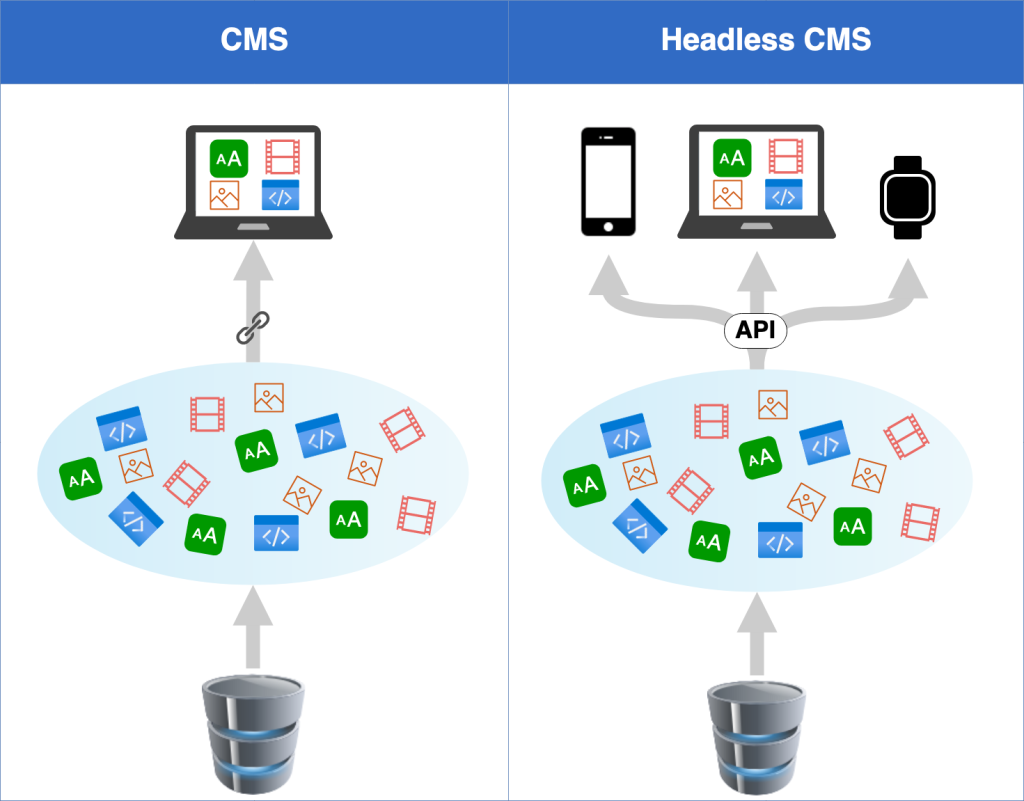
1. Architecture and components
The architecture of a headless CMS is composed of three primary components: the content repository, API layer, and front-end application. The content repository is where all the content is stored, such as text, images, videos, and other assets. The API layer acts as a bridge between the content repository and the front-end application, enabling developers to retrieve the content through, for example, RESTful API calls.
Finally, the front-end application is responsible for rendering the content in a presentation layer, which can be any device or platform, such as a website, mobile app, or wearable device.
2. Comparison with traditional CMS
A traditional CMS combines the content creation, storage, and presentation into one monolithic system, limiting the flexibility of developers to create unique digital experiences. In contrast, a headless CMS decouples the content management from the presentation layer, allowing developers to leverage modern technologies, such as static site generators, serverless functions, and single-page applications.
Overall, a headless CMS provides greater flexibility, scalability, and agility than a traditional CMS, making it an attractive choice for modern web and mobile development.
II. Advantages of Headless CMS
1. Flexibility and scalability
One of the most significant advantages of a headless CMS is its flexibility and scalability. With a headless CMS, content creators have the flexibility to create content once and publish it across multiple channels and devices, such as mobile applications, websites, and smart devices. This approach enables businesses to keep up with the ever-changing technology landscape without the need for costly development efforts. Additionally, headless CMS architectures are highly scalable, meaning that they can easily handle a growing volume of content and traffic without sacrificing performance.
2. Better content delivery
Headless CMS enables businesses to deliver better content experiences to their audiences. By separating the content from the presentation layer, businesses can optimize content for each channel and device without compromising the quality of the content itself. For instance, businesses can deliver personalized content to their audience based on their interests, location, and behavior, leading to higher engagement and conversions.
3. Enhanced security
Another key advantage of headless CMS is enhanced security. Traditional CMS systems are highly vulnerable to attacks because of their complex architecture and a large attack surface. In contrast, headless CMS architectures are simpler, more modular, and easier to secure. With a headless CMS, businesses can leverage modern security standards, such as OAuth2 and JWT, to secure their content and ensure that only authorized users can access it.
4. Improved developer experience
Headless CMS architectures enable developers to focus on what they do best, i.e., building applications and interfaces. With a headless CMS, developers don’t have to worry about the presentation layer or the CMS’s backend functionality, allowing them to build applications more quickly and efficiently. Additionally, developers can choose the programming language and framework of their choice, making it easier to work with the CMS and integrate it with other systems.
III. Challenges of Headless CMS
Headless CMS also comes with its own set of challenges, which can make it a less attractive option for some businesses.
1. Higher technical complexity
One of the main challenges of using a headless CMS is the higher technical complexity involved. With a traditional CMS, developers can rely on a set of pre-built templates and plugins to quickly create a functional website or application. However, with a headless CMS, developers must create custom front-end solutions from scratch, which requires a higher level of technical expertise.
2. Content modeling and management
Another challenge of headless CMS is content modeling and management. With a traditional CMS, content creators have access to a user-friendly interface that allows them to create and manage content in a visual way. However, with a headless CMS, content modeling and management requires more technical knowledge and experience, as content must be structured in a way that can be consumed by the front-end application.
3. Integration with third-party tools
Finally, integrating a headless CMS with third-party tools and services can be a challenge. Unlike traditional CMS platforms, which often have built-in integrations with popular marketing tools and services, headless CMS requires developers to create custom integrations from scratch. This can be time-consuming and costly, particularly for small businesses or startups with limited resources.
Overall, while headless CMS offers many benefits, it may not be the right solution for every business. It is important to carefully consider the technical requirements and resources needed before deciding whether to adopt a headless CMS approach.
IV. Use cases and examples
Headless CMS is being adopted by various industries due to its flexibility and the ability to deliver content across multiple channels. Here are some use cases and examples of headless CMS:
1. E-commerce
Headless CMS is becoming increasingly popular in the e-commerce industry due to the growing demand for omnichannel experiences. Retailers can use headless CMS to store and manage their product information and content, and then deliver that content to various channels, such as mobile apps, voice assistants, social media, and more. This allows retailers to provide a consistent customer experience across all touchpoints, leading to increased customer satisfaction and loyalty. For example, e-commerce giants like Amazon and Walmart are using headless CMS to power their e-commerce sites.
2. Multi-channel publishing
Headless CMS enables content to be created once and published across multiple channels, including web, mobile, social media, and more. This makes it easier for publishers and media companies to create and distribute content at scale. For instance, news outlets can use headless CMS to manage their content and then deliver it to various channels, such as mobile apps, websites, and social media platforms.
3. Mobile apps
Headless CMS is an excellent choice for creating content-rich mobile apps as it allows for the separation of the content management and presentation layers. This means that developers can create a mobile app without worrying about how content will be displayed, and content editors can manage the content without worrying about the presentation layer. This separation of concerns results in faster development and deployment of mobile apps. For instance, a news app can use a headless CMS to manage their content and then deliver it to their mobile app.
4. IoT
The Internet of Things (IoT) is an emerging technology that connects devices and sensors to the internet, allowing them to communicate and exchange data. Headless CMS can be used to manage content for IoT devices, such as smart home devices, wearables, and more. For example, a smart refrigerator can use a headless CMS to manage and display recipe content on its screen.
These are just a few examples of how headless CMS can be used across various industries to deliver content across multiple channels.
V. Future of Headless CMS
As the digital landscape continues to evolve, it’s clear that headless CMS is here to stay. In fact, experts predict that headless CMS will become even more prevalent in the coming years, with many companies already adopting the technology.
One emerging trend in headless CMS is the use of artificial intelligence (AI) and machine learning (ML) to improve content personalization and delivery. With the ability to analyze user behavior and preferences, headless CMS powered by AI and ML can deliver more relevant and targeted content to users, leading to increased engagement and conversion rates.
Another trend is the integration of headless CMS with blockchain technology, which can enhance the security and transparency of content management systems. By using blockchain to verify and track content, headless CMS can provide a tamper-proof and immutable record of all content changes and transactions.
The future of headless CMS also holds exciting possibilities for the Internet of Things (IoT) and voice-activated assistants. As more devices become connected to the internet, there will be a growing need for content to be delivered across a variety of platforms and interfaces. Headless CMS can provide the flexibility and scalability needed to manage content across these channels.
Overall, the future of headless CMS looks bright, with many exciting opportunities for innovation and growth. As the industry continues to evolve, it will be interesting to see how companies leverage headless CMS to improve their digital experiences and stay ahead of the curve.
VI. Headless CMS recommendations
Strapi
Strapi is a popular open-source headless CMS that provides an intuitive administration panel for content management. It offers a wide range of features, including custom content types, plugins, and integrations, and can be easily deployed on various hosting platforms. Strapi is highly flexible and can be adapted to various use cases, including e-commerce, blogging, and mobile app development.
Strapi requires basic knowledge of JavaScript, Node.js, and familiarity with the command line. Experience with MongoDB or PostgreSQL is also recommended.
Directus
Directus is another open-source headless CMS that is known for its highly customizable and extensible architecture. It provides a real-time API for managing content and offers various tools for customizing the content modeling and management workflows. Directus also includes a powerful user interface for managing content, making it an attractive option for businesses and developers who need a flexible and user-friendly CMS platform.
Directus is built on JavaScript and requires some knowledge of Node.js, React, and GraphQL. Familiarity with database management is also recommended.
Appwrite
Appwrite is a relatively new open-source headless CMS that is designed specifically for building serverless applications. It offers a range of features, including database management, authentication, and storage, and provides an easy-to-use API for managing content. Appwrite can be integrated with various front-end frameworks, making it a popular choice for developers who want to build serverless web and mobile applications.
Appwrite requires knowledge of backend development, PHP, including familiarity with RESTful API design, server management, and database management. Experience with JavaScript and Node.js is also recommended.
Contentful
Contentful is a cloud-based headless CMS that provides a range of features, including content modeling, content delivery, and user management. It offers a flexible content model and supports a range of content types, including text, images, and videos. Contentful is highly scalable and can be easily integrated with various third-party tools, making it an attractive option for businesses and developers who need a robust and scalable CMS platform.
Contentful is built on JavaScript and requires knowledge of web development and API design. Familiarity with React, GraphQL, and Node.js is also recommended.
Conclusion
In conclusion, headless CMS is a modern content management approach that separates the content creation, storage, and delivery functions from the presentation layer, enabling greater flexibility, scalability, and customization. By decoupling content from presentation, headless CMS makes it easier to deliver consistent and relevant content across multiple channels and devices, while improving security and developer productivity.
Despite its advantages, headless CMS also presents challenges related to technical complexity, content modeling, and integration with third-party tools, which require careful planning and expertise to overcome.
As for the future of headless CMS, there are several emerging trends and technologies that are likely to shape its evolution, such as artificial intelligence, machine learning, microservices, and blockchain. These innovations could further enhance the capabilities and performance of headless CMS, and open up new use cases and business opportunities.
For businesses and developers considering headless CMS, it’s important to carefully evaluate their requirements, goals, and resources, and choose the right tools and strategies that fit their needs. It’s also advisable to work with experienced vendors, partners, or consultants who can provide guidance and support throughout the implementation and maintenance phases.
Overall, headless CMS is a promising alternative to traditional CMS that offers greater agility, innovation, and customer satisfaction in the digital age. As the demand for omnichannel content experiences continues to grow, headless CMS is likely to play an increasingly important role in shaping the future of content management and delivery.